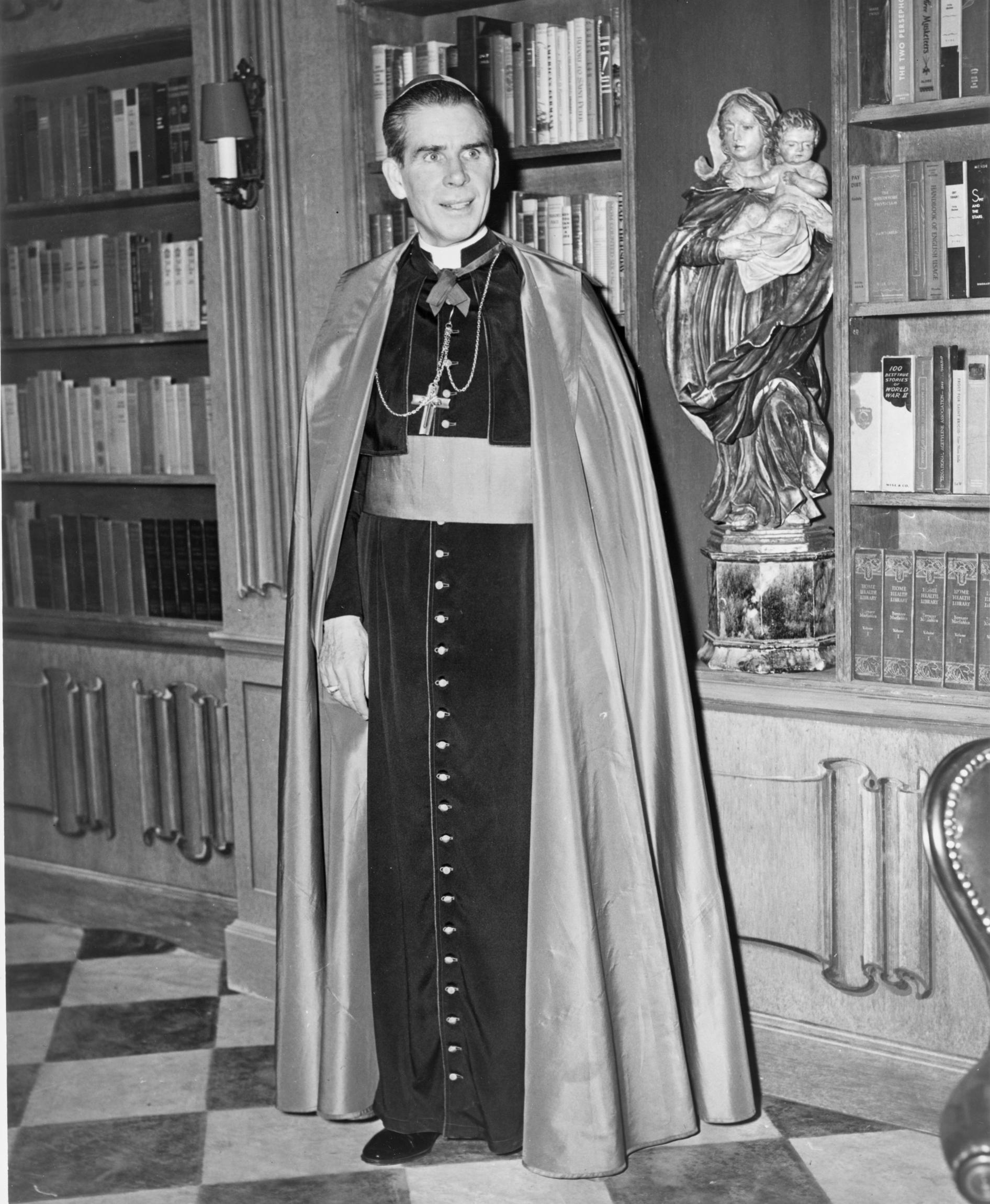
Who Was Archbishop Fulton J. Sheen?
Bishop · Theologian · Broadcaster · 1895–1979
Archbishop Fulton J. Sheen was one of the most recognized Catholic voices of the twentieth century. Born Peter John Sheen on May 8, 1895, in El Paso, Illinois, he rose from a midwestern farming family to become a bishop, a national media personality, and one of the Church's most compelling apologists for the Christian faith in an age of doubt and ideological conflict.
Education and Early Ministry
Sheen studied at Saint Paul Seminary and Saint Viator College before earning a doctorate in philosophy at the Catholic University of Louvain in Belgium — one of Europe's oldest universities — where he graduated with the highest distinction. He joined the faculty of the Catholic University of America in Washington, D.C., where he taught philosophy for more than two decades, becoming known for his ability to make complex theological arguments accessible without sacrificing rigor.
The Catholic Hour
In 1930, Sheen became the first speaker on NBC Radio's The Catholic Hour, a program sponsored by the National Council of Catholic Men. The broadcast reached an estimated audience of four million listeners per week at its peak. Sheen used the radio pulpit to address the major questions of his era: the rise of totalitarianism in Europe, the moral foundations of democracy, the spiritual roots of anxiety, and the universal longing for God. The transcripts from these broadcasts — spanning from 1941 to 1952 — form the core of this archive.
Television and National Fame
In 1951, Sheen brought his ministry to television with Life Is Worth Living, which aired on the DuMont Network and later ABC. Broadcasting without notes or a teleprompter, he addressed audiences of up to thirty million viewers per week. The show won an Emmy Award in 1952 — beating out Lucille Ball and Arthur Godfrey — and ran for six years. Sheen's combination of philosophical depth, rhetorical skill, and genuine warmth made him one of the first Catholic figures to achieve mainstream American celebrity.
His Teaching
Sheen's central preoccupation was the encounter between Christian faith and modern life. He addressed suffering not as an obstacle to belief but as a doorway to it; he engaged communism not with paranoia but with a philosophical counter-argument; he spoke about the Eucharist, prayer, and the moral life in language ordinary people could follow. His approach was always evangelical in the root sense — aimed at those outside or on the margins of faith — without compromising doctrinal substance.
His major books — among them Peace of Soul (1949), Life of Christ (1958), and Three to Get Married (1951) — remain in print and are widely read in Catholic formation programs.
Later Life and Legacy
Sheen served as Bishop of Rochester, New York (1966–1969) and was later appointed to the titular see of Newport, Wales. He died on December 9, 1979, in New York City. His cause for canonization was opened in 2002; he was declared Venerable in 2012, recognizing his heroic virtue. The Diocese of Peoria has announced his beatification — the penultimate step before sainthood — on September 24, 2026.